

Executive summary
- Quick Verdict
- Who This Comparison Is For
- At a Glance
- The Scoring Matrix
- What Each One Costs You After You Register
- Getting Back Out Again
- Pricing and Renewal Costs
- Domain Extensions and Availability
- Ease of Use and Dashboard Experience
- DNS and Performance
- Security
- Privacy and WHOIS Protection
- Support and Documentation
- Email, SSL and Extras
- Developer and Agency Use
- Which Should You Choose?
- The Third Option Most People Want
- Final Verdict
- Frequently Asked Questions
- People Also Ask
- Sources
- Further reading
The short answer
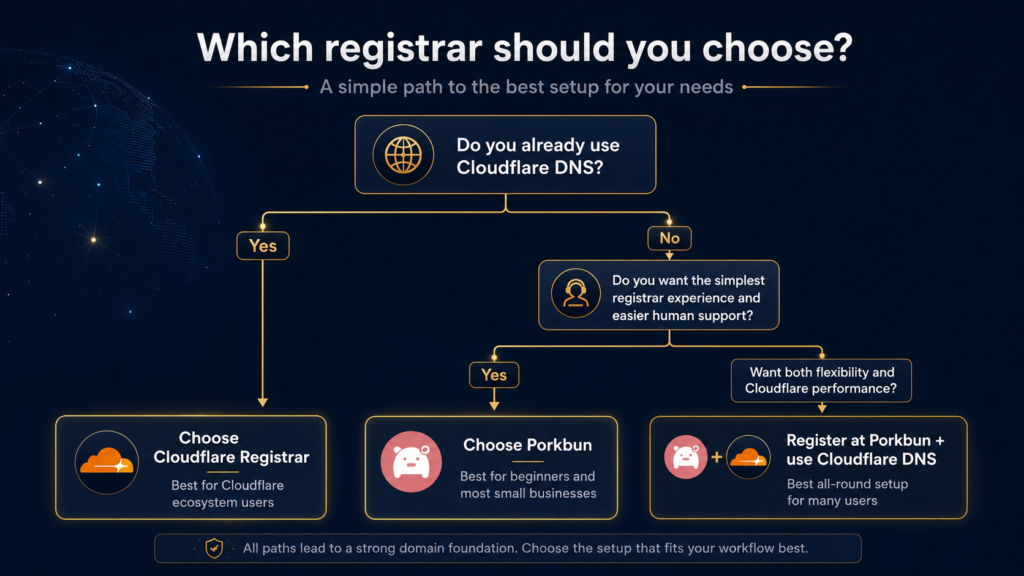
- Pick Porkbun if: you want to buy a name and get on with it. More extensions, a simpler dashboard, reachable human support, and your DNS stays portable.
- Pick Cloudflare if: the domain’s DNS is already on Cloudflare, or you have decided it will be. At-cost pricing, registration equals renewal, and one dashboard for everything.
- Do both if: you want Porkbun’s flexibility and Cloudflare’s DNS. Register at Porkbun, then point the nameservers at Cloudflare. That is the setup most readers end up wanting.
Cloudflare gives you the lowest, most honest pricing and locks you into its DNS. Porkbun gives you flexibility, breadth and hand-holding at prices that are still very low.
Quick Verdict
Porkbun is the better all-round registrar for most people: more extensions, simpler for non-technical owners, easier support, and useful free extras with no upsell pressure. However, Cloudflare Registrar wins in one specific case — when the domain’s DNS is already on Cloudflare. In that situation, its at-cost pricing and single dashboard are hard to beat.
A third option is legitimate and often best: register at Porkbun and use Cloudflare for DNS and CDN. That combination captures most of the upside of both, and it is what we would point the largest share of readers toward. Accordingly, it is covered in its own section below.
Who This Comparison Is For
This is for anyone deciding where to register and manage domains — not where to build a full hosting stack. Specifically, that means entrepreneurs, freelancers and sole proprietors buying a first company domain. It also means bloggers and creators who want a clean name and simple management, developers who care about API access and DNS control, and agencies managing names on behalf of clients.
In practice, the question most readers have is narrower than “which company is better.” It is usually: should I register at Cloudflare, register at Porkbun, or register at Porkbun and run DNS through Cloudflare? This answers that directly.
At a Glance
Both registrars include free WHOIS privacy, both sell a .com for roughly ten dollars, and both are far cheaper than the legacy names. Beyond that, they diverge sharply: Cloudflare is at-cost and DNS-locked, whereas Porkbun is broad, beginner-friendly and portable. The table below is the whole comparison in one screen.
| Cloudflare Registrar | Porkbun | |
|---|---|---|
| Best for | People already using Cloudflare DNS or CDN; price purists | Beginners, bloggers, small businesses, most solo builders |
| Pricing approach | At-cost wholesale, no markup; registration equals renewal | Low flat pricing; frequent first-year promos, honest renewals |
| WHOIS privacy | Free redaction by default | Free, where the registry allows it |
| DNS | Cloudflare’s own — fast, advanced, mandatory | Solid and clean; you can also point elsewhere |
| Support | Docs and community strong; human support thin on the free tier | Email and chat, responsive and beginner-friendly |
| Email Routing forwarding, configured separately | Free email forwarding included; hosting available | |
| Developer and API | Full Cloudflare API ecosystem; Registrar API in beta | Clean, well-used domain and DNS API |
| Marketplace and upsells | None | Minimal; optional add-ons, not pushy |
| Ease of use | Easy if you are in the ecosystem; awkward if not | Easy for everyone |
| Main drawback | Cannot buy a name and host DNS elsewhere | First-year promos can undercut renewals |
The Scoring Matrix
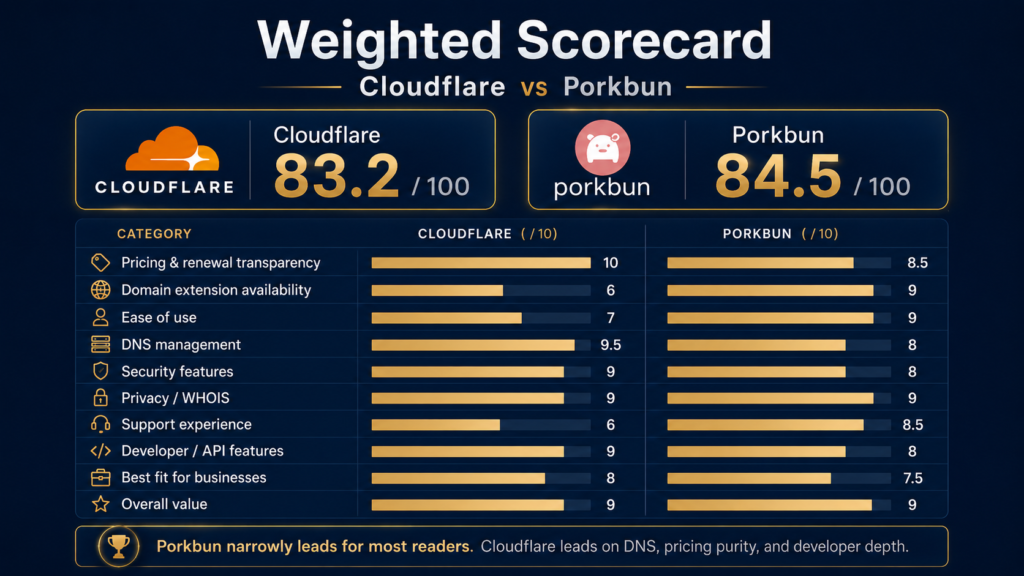
Ten categories, weighted by how much each should matter to the decision, with the weights adding to 100. Porkbun finishes on 84.5 and Cloudflare on 83.2. Each category is scored out of five, so the table shows both scores side by side and names who leads.
| Category | Weight | Porkbun | Cloudflare | Leads |
|---|---|---|---|---|
| Pricing transparency | 15 | 4.25 | 5.0 | Cloudflare |
| Extension availability | 10 | 4.5 | 3.0 | Porkbun |
| Ease of use | 12 | 4.5 | 3.5 | Porkbun |
| DNS management | 12 | 4.0 | 4.75 | Cloudflare |
| Security features | 12 | 4.0 | 4.5 | Cloudflare |
| Privacy and WHOIS | 8 | 4.5 | 4.5 | Level |
| Support experience | 10 | 4.25 | 3.0 | Porkbun |
| Developer and API | 11 | 4.0 | 4.5 | Cloudflare |
| Fit for businesses | 5 | 3.75 | 4.0 | Cloudflare |
| Overall value | 5 | 4.5 | 4.5 | Level |
| Weighted total | 100 | 84.5 | 83.2 | Porkbun |
Porkbun edges ahead for the general reader on breadth, ease and support. Cloudflare, by contrast, leads on pricing purity, DNS and developer depth. The scores reflect meaningful differences rather than invented decimals — so read them as “very close, Porkbun slightly ahead for most people, Cloudflare ahead for ecosystem users.”
What Each One Costs You After You Register
Every registrar comparison prices the sticker and stops. The sticker on a .com is about ten dollars at either of these, which means it is the least interesting number on the page. What actually separates them is what happens over the following five years, and that is what this table prices.
| What it takes | Cloudflare | Porkbun |
|---|---|---|
| Moving DNS before you can even register or transfer | Required, once | None |
| Renewal drift you have to check each year | None. Registration equals renewal, guaranteed | Promo year one, then the real price |
| Getting a human when a transfer goes wrong | Docs and forums on the free tier | Email and chat |
| Changing DNS provider later | Not possible while the domain stays there | Change the nameservers, done |
| Finding out your TLD is not carried | ~390 TLDs, no Unicode | 560 or more |
| Fending off upsells at checkout and renewal | None | Minimal |
Getting Back Out Again
Porkbun keeps the registration and the DNS as separate decisions, so either can change without the other. Cloudflare fuses them: you cannot move in without moving your DNS first, and you cannot move your DNS out without also moving the registration. This is the section nobody writes, yet it decides more cases than price does.
| The exit route | What it takes |
|---|---|
| Leaving Porkbun | Unlock, take the auth code, transfer. DNS already portable. |
| Leaving Cloudflare | Same transfer, but your DNS has to move at the same time. |
| Entering Cloudflare | Only accepts domains already live on Cloudflare’s own nameservers. |
Neither company is doing anything underhanded — Cloudflare is upfront about it. Even so, a decision that is cheap to reverse is worth something, and only one of these two is.
Pricing and Renewal Costs
The headline difference is philosophy. Cloudflare charges exactly what the registry and ICANN charge — no markup on registration or renewal. A domain registers and renews at the same wholesale price, with no first-year loss-leader and no renewal spike. As of February 2026, Cloudflare listed .com at about $10.11 a year for both registration and renewal, with .org near $10.11, .net around $10.76, .dev around $12.18, and .io around $33.98. Cloudflare states plainly that it does not mark up domain prices at all.
Porkbun, on the other hand, competes on low flat pricing plus aggressive first-year promotions. As of mid-2026 its .com sat around $9–11 to register and roughly $9.77–11 to renew, with heavier promos on newer TLDs — .io discounted well below its roughly $38 renewal in the first year, for example. Porkbun is unusually transparent about renewals for a discount registrar and publicly commits to not raising prices to recoup promos. The honest caveat stands anyway: a promotional first-year price can be lower than the renewal, so budget on the renewal number, not the sign-up number.
Which is cheaper?
For a plain .com held long-term the two are close, and Cloudflare’s guaranteed registration-equals-renewal model is the safest bet against surprises. For a newer or specialty TLD in year one, however, Porkbun’s promos often win up front. Neither is universally cheapest — it depends on the exact TLD and on whether you are pricing year one or year five. In short, Cloudflare is the most predictable, Porkbun is frequently the lowest at signup, and both are far cheaper than legacy registrars that quietly triple renewals.
Domain Extensions and Availability
Porkbun wins clearly on breadth. It offers well over 500 extensions, roughly 560 or more as of 2026, including a deep bench of niche, country-code and specialty TLDs. Consequently, if you want something unusual — a quirky new gTLD, a specific ccTLD, or a creator-friendly extension — Porkbun is more likely to carry it.
Cloudflare supports a large but narrower catalogue, around 390 or more TLDs, focused on the common and developer-relevant ones: .com, .net, .org, .ai, .app, .dev and similar. Two limitations matter. First, Cloudflare does not support internationalised domain names. Second, its ccTLD coverage is thinner.
Because availability varies name by name, the practical advice is simple: check both registrars for the exact extension you want before deciding. If your preferred TLD is not on Cloudflare’s list, that alone settles it.
Ease of Use and Dashboard Experience
For a non-technical owner who just wants to buy a name and manage it, Porkbun is the friendlier experience. Registration is straightforward, the dashboard is uncluttered, privacy and SSL are already on, and nothing pressures you toward add-ons. As a result, you can register a domain and point it wherever you like.
Cloudflare’s ease-of-use story is conditional. If you are already using Cloudflare for DNS, CDN or security, adding the registrar is natural: everything lives in one dashboard and buying at cost is a bonus. If you are not in that ecosystem, though, the model feels restrictive. To hold a domain at Cloudflare Registrar you must run its DNS through Cloudflare, so “just buy a domain” becomes “adopt Cloudflare’s DNS for that domain.” Fine for many people, a dealbreaker for others.
DNS and Performance
Cloudflare operates one of the largest and fastest authoritative DNS networks in the world, and every Cloudflare Registrar domain uses it. You get quick propagation, a capable record editor, free DNSSEC, and a direct on-ramp to Cloudflare’s CDN, WAF and security products. For DNS power and reach, therefore, Cloudflare is the stronger platform.
Porkbun’s DNS is solid, clean and more than enough for typical sites — custom records, DNSSEC support, a usable console — but it is not trying to be a global performance network.
Security
Both cover the fundamentals well, with Cloudflare offering more at the high end. Specifically, the two differ on hardware-key support, registry lock and out-of-band verification, and the details below show where each one goes beyond the basics.
Cloudflare includes free one-click DNSSEC, default WHOIS redaction, and account two-factor authentication including authenticator apps and hardware security keys. For higher-value domains it offers registry lock and out-of-band verification designed to prevent hijacking, plus stricter protections on Enterprise plans. Because every domain sits on Cloudflare’s DNS, you also inherit its DNS-layer security posture.
Porkbun, meanwhile, provides free app-based TOTP two-factor authentication, standard domain locking and transfer controls, and DNSSEC support. That covers what a typical owner needs.
The meaningful gap is at the top: for high-value or brand-critical domains, Cloudflare’s registry lock and out-of-band controls are a real advantage. For everyday domains, on the other hand, both are secure once you turn on 2FA and keep the domain locked.
Privacy and WHOIS Protection
Both include WHOIS privacy for free, which is the right baseline in 2026. Cloudflare redacts personal contact details by default on supported domains. Similarly, Porkbun automatically applies WHOIS privacy on every extension that allows it, replacing your details with a privacy service.
The honest caveat applies to both: privacy availability is governed by registry and ccTLD rules, not the registrar’s goodwill. Some extensions do not permit masked WHOIS, and neither registrar can override registry policy. For mainstream TLDs you get free privacy at either. For certain ccTLDs, however, privacy may be limited or unavailable regardless of who you register with. Check the specific TLD.
Support and Documentation
Cloudflare’s strength is documentation. Its developer and support docs are extensive, precise and excellent for technical users solving DNS, registrar and security problems. What is thinner is human, hands-on support for domain questions on lower tiers: free-plan support leans on documentation and community forums, and there is no general phone line for basic registrar issues. Fine if you are technical and self-serve. Less comforting, though, if you want someone to walk you through a transfer.
Porkbun’s strength is approachable human support — responsive email and chat with a friendly reputation, backed by a practical knowledge base. For a small business owner or blogger who wants a person to answer a domain question, therefore, Porkbun is the easier place to get help.
Email, SSL and Extras
Both registrars bundle the extras a domain owner actually uses — email forwarding and SSL — at no charge. The difference is where they live: Porkbun ships them as registrar checkboxes, whereas Cloudflare provides them through its DNS and CDN layer. Neither pushes paid add-ons.
- Email forwarding. Porkbun includes free email forwarding out of the box. Cloudflare offers Email Routing, also free, configured as a separate Cloudflare feature rather than a registrar checkbox.
- SSL. Porkbun bundles free Let’s Encrypt certificates, auto-renewing when you use Porkbun’s DNS or hosting. Cloudflare provides free SSL through its DNS and CDN layer once a domain is proxied — again an ecosystem feature rather than a registrar add-on.
- Add-ons. Porkbun has optional extras but does not hard-sell them. Cloudflare has essentially no registrar upsells — no privacy fees, no padded add-ons — which is part of its appeal.
Developer and Agency Use
Cloudflare is the deeper platform: a mature, well-documented API across DNS and security, Terraform support, and a Registrar API in beta. If your team already automates infrastructure through Cloudflare, managing domains there consolidates everything into one control plane and one set of credentials.
Porkbun offers a clean, widely used domain and DNS API, popular for automating registration, records, DNSSEC and SSL, with community tooling built around it. In other words, it is straightforward and dependable for domain-centric automation.
For agencies managing many client domains, the calculus is portability. Porkbun keeps domains DNS-agnostic, which is useful when clients host DNS in different places. Cloudflare, conversely, centralises and standardises, which is powerful if all clients live on Cloudflare and constraining if they do not.
Which Should You Choose?
Choose Porkbun if you want a name, a simple dashboard and the freedom to change DNS later. Choose Cloudflare if your DNS already lives there, or you need registry lock for a flagship domain. Below, each situation is matched to a pick, followed by both score plates.
| If you… | Choose |
|---|---|
| Are a beginner, or you just want to buy a name and get on with it | Porkbun |
| Want a TLD Cloudflare does not carry, or an internationalised name | Porkbun |
| Want to be able to change DNS provider later without moving the domain | Porkbun |
| Would rather email a person than read documentation | Porkbun |
| Run an agency with clients on mixed DNS setups | Porkbun |
| Care about first-year promo pricing | Porkbun |
| Already have your DNS on Cloudflare, or have decided it will be | Cloudflare |
| Want the most predictable long-run cost: registration equals renewal | Cloudflare |
| Need registry lock for a flagship or brand-critical domain | Cloudflare |
| Automate infrastructure through Cloudflare’s API or Terraform | Cloudflare |
| Keep your whole client portfolio on Cloudflare | Cloudflare |
| Want one dashboard for domain, DNS, CDN and security | Cloudflare |
The score plates
Both land on 4.2 out of 5. Consequently, the plates below describe where each one leads and trails rather than declaring a winner; the decision table above is what should decide it.
The better default registrar for most people.
84.5 out of 100 on the weighted matrix. Leads on extensions, ease of use and support; trails on pricing transparency, DNS and developer depth. Registration and DNS stay separate decisions.
The better pick when your DNS is already on Cloudflare.
83.2 out of 100 on the weighted matrix. Leads on pricing transparency, DNS and developer depth; trails on extensions, ease of use and support. Must use Cloudflare nameservers.
The Third Option Most People Want
Register at Porkbun, then run DNS through Cloudflare. You get breadth and flexibility at the registrar, plus Cloudflare’s DNS, CDN and security on top. Crucially, you keep the ability to change either side without touching the other, which is the thing registering at Cloudflare costs you. This is the setup we would point the largest share of readers toward.
Final Verdict
For the typical reader choosing a registrar today, Porkbun is the better default. It sells more extensions, it is easier for non-technical owners, its support is more reachable, and its free WHOIS privacy, SSL and email forwarding cover what most domain owners actually need at prices that stay low. Above all, it keeps your DNS portable, which preserves every future option — including using Cloudflare.
Cloudflare Registrar is the better pick when you are already living in Cloudflare’s ecosystem, or plan to be. Its at-cost, no-markup pricing is the most honest in the business, its DNS and developer tooling are stronger, and single-pane management is a real convenience. Nevertheless, the one hard constraint decides many cases: you must use Cloudflare’s nameservers, and you can only bring over domains already active on Cloudflare. If that fits, Cloudflare is excellent. If it does not, it is the wrong tool.
Frequently Asked Questions
The questions people type into search after reading a comparison like this one, answered in a sentence or two each. In every case, the DNS question decides more than the price does.
Is Cloudflare cheaper than Porkbun?
Often, but not always. Cloudflare sells at true wholesale cost with identical registration and renewal prices, so it is the most predictable. Porkbun is frequently cheaper in the first year thanks to promos, and comparable on renewals. As of July 2026 a .com is roughly $10 at either.
Is Porkbun better for beginners?
Generally yes. The dashboard is simpler, privacy and SSL are already enabled, there is no ecosystem requirement, and human support is easy to reach.
Can I use Porkbun with Cloudflare DNS?
Yes, and it is a popular setup. Register the domain at Porkbun, then point its nameservers to Cloudflare to use Cloudflare’s DNS, CDN and security. Porkbun does not lock you to its own DNS.
Can I transfer a domain from Porkbun to Cloudflare?
Yes, with a prerequisite: Cloudflare Registrar only accepts domains already active on Cloudflare’s full DNS setup, using Cloudflare’s nameservers. Add the domain to Cloudflare’s DNS first, then transfer the registration.
Do I have to use Cloudflare’s nameservers if I register there?
Yes. Every Cloudflare Registrar domain uses Cloudflare nameservers, and you cannot switch to a third-party DNS provider while the domain stays at Cloudflare. That is the single biggest thing to know before registering there.
People Also Ask
Four more questions, this time about who each registrar suits. In short, DNS strength and developer depth point to Cloudflare, while privacy is a tie and small businesses mostly land at Porkbun.
Which has better DNS?
Cloudflare — it runs one of the world’s largest and fastest DNS networks. Porkbun’s DNS is solid and sufficient for typical sites but is not a global performance platform. Note that the DNS host, not the registrar, is what affects performance.
Which is better for privacy?
Effectively a tie. Both include free WHOIS privacy by default, and both are limited only by registry rules on certain TLDs.
Which is better for small businesses?
Porkbun for most, thanks to ease and support. Choose Cloudflare if your business already runs on Cloudflare, or you want registry lock for a high-value brand domain.
Which is better for developers?
Cloudflare if you automate infrastructure on its platform: mature API, Terraform, Registrar API in beta. Porkbun if you want a straightforward, DNS-agnostic registrar with a clean, well-used API.
Sources
Every pricing, feature, privacy, security and support claim above traces to one of the sources below. Official vendor pages come first; the two third-party trackers are used for pricing context only. Prices are a mid-2026 snapshot and should be reverified at the registrar before purchase.
Official and primary
- Cloudflare Registrar product page
- Cloudflare — Is Cloudflare a domain registrar?
- Cloudflare Registrar developer docs
- Cloudflare Registrar — register a domain, prerequisites
- Cloudflare Registrar FAQ — transfer requirements and nameservers
- Cloudflare domain search and registration
- Porkbun — free domain features
- Porkbun — free WHOIS privacy and TLD exclusions
- Porkbun — two-factor authentication
Secondary, pricing context only, mid-2026
Further reading
If you are choosing a registrar as part of setting up a firm’s website, the two comparisons below cover the next decision: where the site itself lives. The methodology page explains how every VerityLoft score is built.