
Every review and comparison on VerityLoft follows the process on this page. It is published for two reasons: so you can judge our judgment, and so you can tell whether two of our scores actually mean the same thing.

How products get here
We buy or trial our own access. We do not accept vendor-provided accounts, pre-configured demo environments, or a guided walkthrough in place of using the thing ourselves. Where the trial hides the features that matter, we pay for the entry tier.
No vendor previews a review before publication or gets an opportunity to adjust a score.

What qualifies for review
Five criteria, all of which must be met:
- Self-serve access. There must be a trial, a free tier, or a purchasable entry plan.
- Obtainable pricing. Available without becoming a sales lead.
- Available to Canadian firms. Legally and practically accessible from Canada.
- Built for firms under fifty staff. That is who this publication is for.
- A real integration story. Outside Zone 0, it has to connect to the general ledger.
On coverage: we prioritise the categories where a purchasing decision matters most and is hardest to reverse. That is a commercial judgment, and it is kept separate from how anything is scored.
Minimum time before we publish

What the scores mean
Products score out of 5, to one decimal place. The score is a weighted average: 40% shared criteria that apply to every product, and 60% zone-specific criteria that depend on what the product is for.
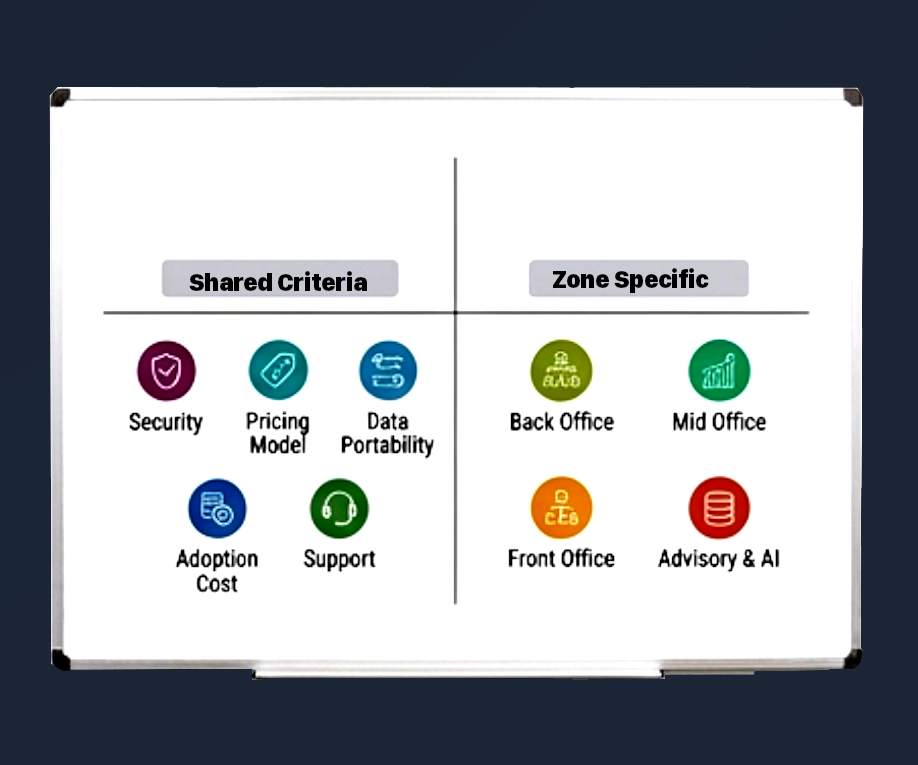
Shared criteria — 40% of every score
| Criterion | Weight | What we measure |
|---|---|---|
| Adoption cost | 8% | Time and friction to implement and get people using it |
| Pricing model | 8% | How cost behaves as staff and client count grow |
| Support | 8% | Response time and usefulness on real questions |
| Data portability | 8% | Export options, formats, and the cost of leaving |
| Security posture | 8% | Access control, MFA, data handling, disclosure history |
Reading a score
Scores compare within a zone, not across zones. A 4.2 in Back Office and a 4.2 in Zone 0 are not the same claim — different criteria, different weights.
Zone protocols
Five functional zones, from the 4-Zone architecture. Each zone has its own five criteria making up the other 60% of the score. Open one to see what it measures.
Zone 0Foundational IT security infrastructurePassword managers, identity and MFA, backup, VPN, hosting, endpoint protection
| Offboarding and revocation | 15% | Time for departing staff to lose all client file access |
| Client data isolation | 12% | Can staff be scoped to their own clients, and can you verify it |
| Recovery, actually tested | 12% | Timed backup restoration — not theoretical |
| Audit evidence | 11% | Exportable logs an auditor or insurer would accept |
| Admin burden at firm scale | 10% | Can one person manage it across 1–20 seats |
Zone 1Front office — attract, host and convert clientsWebsites, hosting, scheduling, intake, signatures
| Intake-to-record integrity | 14% | Single entry, or re-keying client details |
| Time to client-facing asset | 12% | Hours from empty account to something a prospect can see |
| Booking and follow-through | 12% | Calendar, reminders, reschedules, no-shows |
| Content ownership and exit | 12% | Can you take the site, content and domain with you |
| Trust surface | 10% | Certificates, privacy handling, professional appearance |
Zone 2Mid office — engagement, scope and billingEngagement letters, scope control, automated billing
| Scope-change capture | 16% | Is out-of-scope work caught in real time, or written off |
| Engagement-to-invoice continuity | 13% | One source for letter, fee and invoice — or three |
| Collection and dunning | 11% | Automated non-payment handling, and how clients perceive it |
| Repricing across a book | 10% | Hours to apply a rate change across eighty clients |
| Realisation visibility | 10% | Billed versus delivered, visible monthly |
Zone 3Back office — practice management, app sprawl and complianceWorkflow, capacity, documents, integrations
| Workflow fidelity | 15% | Recurring jobs, dependencies and handoffs in filing season |
| Ledger integration depth | 13% | QuickBooks Online / Xero sync — coverage and direction |
| Capacity and lateness visibility | 12% | Overload and slippage, without a manual spreadsheet |
| Document handling and chasing | 12% | Client documents retrieved without manual reminders |
| Behaviour at scale | 8% | What changes between fifty and five hundred clients |
Zone 4Advisory & AI — virtual CFO capacity and automated intelligenceCompliance-to-advisory, forecasting, AI-assisted output
| Traceability of output | 16% | Can a number in a client report be traced to source transactions |
| Data freshness and sync | 12% | How stale data can get, and whether the tool tells you |
| Scenario and forecast depth | 11% | Does the model survive a realistic client question |
| Client-ready presentation | 11% | Usable as-is, or needs a spreadsheet pass first |
| Failure behaviour | 10% | Flags uncertainty, or states wrong things confidently |
What we can’t test
Testing happens from Canada. That creates three limits we will not pretend around:
- Geographically restricted behaviour. Regional availability and geo-features are testable only from a Canadian location.
- Non-Canadian government portals. Filing, authentication and integration against foreign systems cannot be tested.
- Products that need a live client base. Tools that only prove themselves with real client movement cannot be scored on a simulation.

Disqualifiers
Two things override the score entirely:
- No usable data export. You must be able to get your own client data out in a readable format.
- No MFA on accounts holding client financial data.
A disqualifier we would not actually enforce is worth nothing.
How we make money
The person doing the testing is a licensed electrician and IBEW member. Electrical work is the primary income. VerityLoft is not a revenue necessity — which means no single review has to convert, and no vendor has to be kept happy.

- Buy or trial our own access, including paid entry tiers
- Disclose affiliate links in the article header
- Publish the rubric and weights before scoring
- Name the cheaper or smaller product when it wins
- Say which categories we cover and why
- Paid placements or sponsored reviews
- Score adjustments, for any reason
- Weighting tuned to favour higher-paying products
- Advance copy or approval rights
- Vendor-supplied demo accounts
Corrections
Confirmed errors are corrected, dated, and noted. Nothing is silently edited after publication.
Questions
- Why out of 5 rather than 100?
- It matches the scale sources readers already use, and one decimal place is enough to separate recommendations.
- Why isn’t [product] reviewed?
- Usually it fails a qualifying criterion — most often no self-serve access, or enterprise-only positioning. Absence is not a verdict.
- Do vendors preview reviews?
- No. No advance copy, no approval rights, no opportunity to dispute a score before publication.
- Do affiliate links change scores?
- No. Affiliate relationships are disclosed after scoring is complete. The weights are published, so you can check the arithmetic. Several reviews recommend the cheaper option.
- Can I suggest a product?
- Yes, via the contact page. Suggestions are welcome from readers and from vendors; the only guarantee is consideration. Where a vendor suggested a product, the review says so.
- What about reviews from before this page?
- They are marked as predating the documented process, and their scores are not directly comparable to newer ones. They get re-scored when their zone is revisited.
Version history
| Version | Date | Change |
|---|---|---|
| 1.0 | 30 August 2026 | Initial publication, with shared and zone criteria |
Reviews published before 30 August 2026 used an undocumented process and are marked accordingly.
See it applied
Every review on the site follows this process. Pick one and check the arithmetic.